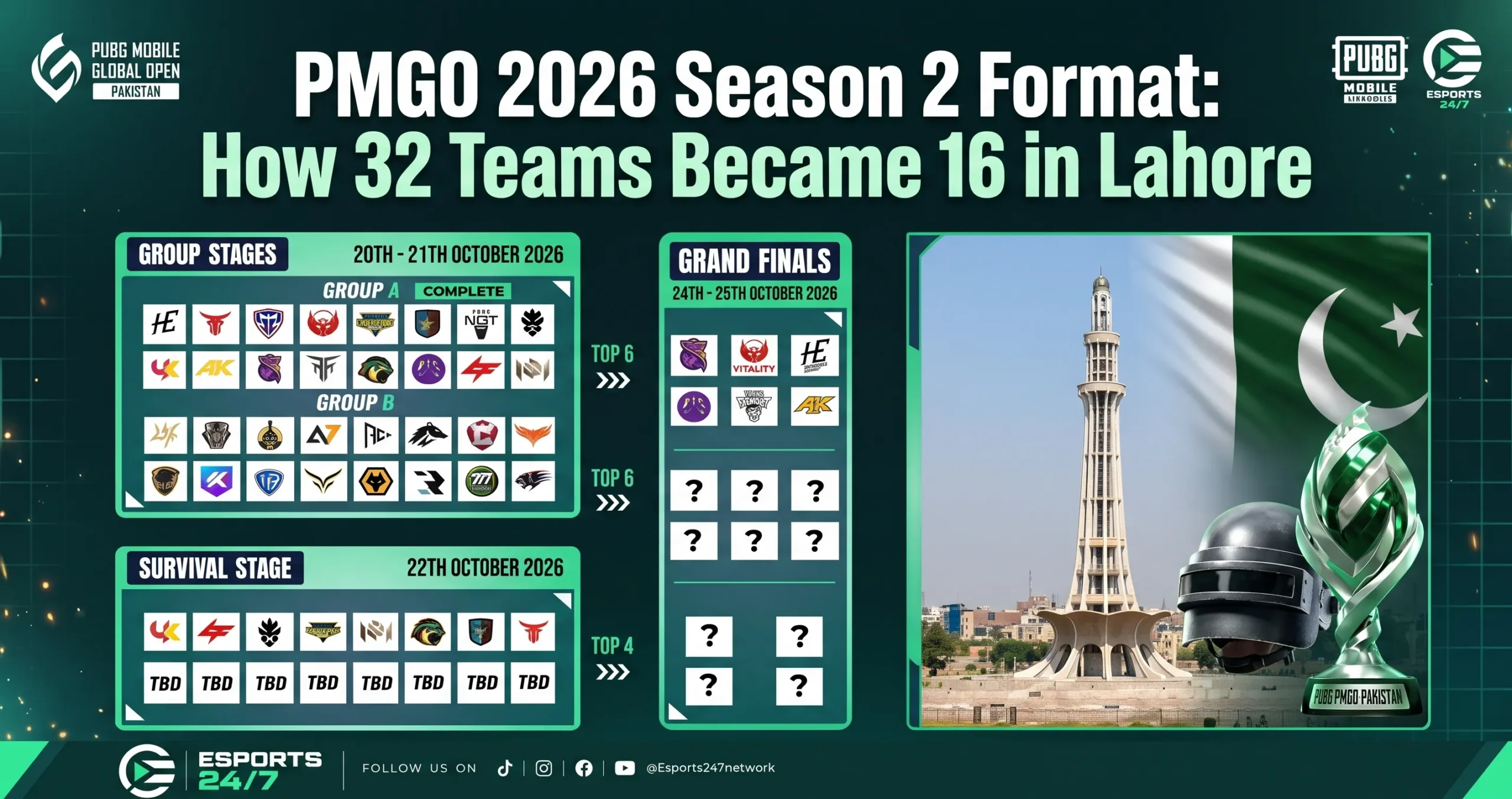
At PMGO 2026 Season 2 in Lahore, the opening stage offered a direct route to the Grand Finals. It also left room for a comeback. Of the 32 teams that entered the main event, 12 reached the final through their groups and four earned a place through the Survival Stage.
The group route
The publisher split the field into two groups of 16. Each group played six matches. The top six teams in each group advanced directly to the Grand Finals, while seventh through 14th moved into Survival. The bottom two from each group were eliminated. Survival brought the remaining 16 together to compete for the last four finals places.
Warehouse tiebreaks
The announced format used a best-of-three, four-versus-four Warehouse Team Deathmatch for ties that affected a qualification slot in the Group or Survival Stage. The scope matters when reading the standings. The rule addressed a tie that changed who advanced.
Why the rules mentioned Match 13
The organizer planned a themed showmatch before Match 7. Its winner would get to ban a map from the options for a possible Match 13. The extra match would take place only if no champion had been crowned under SMASH rules by the end of Match 12. That conditional match is part of the announced format. The final match record is the source for what was actually played.
The group-stage arithmetic
The two groups began with 16 squads each. Taking the first six from each group created 12 direct finalists. The teams in seventh through 14th made up eight from each group, giving Survival a field of 16. Four teams therefore left the tournament at the group stage. Once Survival awarded four places, the Grand Finals field was set. This is a useful way to follow a bracket graphic when several cutoffs appear on the same screen.
Two rule changes addressed different questions
The Warehouse tiebreak addressed who advanced when a tie affected a qualification place. The possible extra Grand Finals match concerned how the tournament could conclude if the championship remained unresolved after Match 12 under the announced conditions. The showmatch connected to that second provision through map selection. They are two separate rules. An announced rule can shape expectations even if the circumstances that trigger it never occur.
For a reader following a specific squad, the quickest route through the format is to begin with its group position. That position determines whether to look next at the finals list, the Survival standings or the group-stage record. That is why the stage matters next to every placement. A sixth-place finish in one part of the tournament can have a different meaning from sixth place somewhere else.
Walk through the three stages
A simple way to read the bracket is to ask what a team needed from its next lobby. In its group, a squad could target a direct final place or remain in contention through Survival. In Survival, the available places narrowed to four. The Grand Finals then decided the champion. Each stage therefore had a different cutoff and outcome. A reader who sees a team sixth on a graphic needs the stage label before that position means anything. Sixth was enough to advance directly from a group, while the Survival cutoff was fourth.
How the announcement split the calendar
The format release lists Group A for October 20 and Group B for October 21. Survival followed on October 22, and the Grand Finals were scheduled for October 24 and 25. This chronology explains why group results could be reported separately even though both groups fed into the same final field. The dates in the announcement are the planned schedule. For when a match was actually played, check the event record.
Why the tiebreak threshold mattered
A tied points total only triggered the announced Warehouse procedure when a place in the next stage was at stake. Imagine two squads tied at the boundary of a group’s direct finals places. The question would be which squad advanced directly under the event rules. If the same score occurred well above the cutoff, the qualification question would be different. Read the organizer’s exact provision before assuming that every pair of tied teams played a separate Team Deathmatch.
Keep the planned format beside the actual result
A format preview describes everything the organizer planned for. The results show what actually happened. This matters for the showmatch and the possible extra match. The map ban only came into play if the extra match was needed. The final match record shows whether the competition reached that point.
The broader event context
The announcement lists a $500,000 prize pool and describes Lahore as Pakistan’s first official global PUBG Mobile esports event. Those two details explain why the format drew attention beyond the competition itself.
Frequently asked questions
How many teams qualified directly from the groups?
Twelve teams went straight to the Grand Finals, six from each group. The official finalists release names S2G Esports and Wolves Esports as the teams that topped their groups. The other four Grand Finals places came from Survival. If you are tracing a particular team’s route, check the group result first. The finals participant list confirms attendance, while the stage results explain how that place was earned.
What happened to teams that finished seventh to 14th?
Those positions went to the Survival Stage. With eight squads from each group, 16 teams played for four Grand Finals places. This gave squads outside the top six another route to the final. A team could be outside the direct cutoff in its group and still finish Survival in a qualifying spot.
How did the Warehouse tiebreak work?
The announcement described a best-of-three, four-versus-four Team Deathmatch on Warehouse when a tie affected qualification in the Group or Survival Stage. The publisher said a round could be won by reaching 15 eliminations first or leading when time expired. It also described how a drawn round would be settled. The original release has the full procedure.
What was the showmatch winner’s reward?
The organizer said the showmatch winner would earn the right to ban one of three map options for a potential Match 13. If that extra match was needed, the team leading after Match 12 would select from the remaining options. The announcement tied the showmatch to map choice. To establish which map was picked or whether the decision was needed at all, consult the official finals record.
Was Match 13 guaranteed to take place?
No. The announced format made Match 13 conditional on the championship still being undecided under SMASH rules after Match 12. Whether it was played is shown in the official match record or the broadcast.